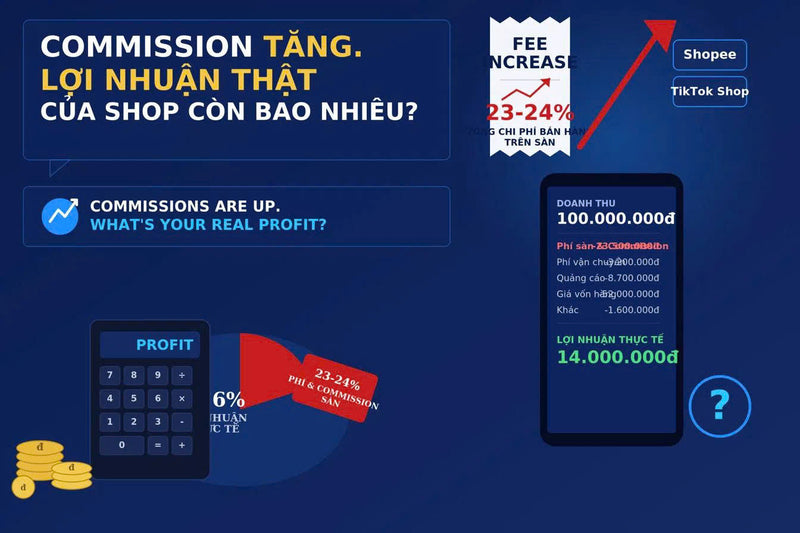
Platform fees take almost a quarter of your revenue. Do you know what your shop actually earns?
Platform fees don't stop at commission. Add everything up and the figure usually lands between 18 and 25% of revenue. This piece names the three costs most often missed, and shows how to work out what each sales channel really earns.

Most shop owners know they pay fees to the marketplaces. Few ever sit down and add all of them up in one place.
Commission. Shipping. In-app advertising. Compulsory promotion programmes. Returns. Payment processing. And on some platforms, a monthly storefront fee on top.
Put together, the total usually lands somewhere between 18 and 25% of revenue, depending on the platform and the category.
On 10 million VND of revenue, that is 2 to 2.5 million gone to the platform alone — before cost of goods, before staff, before anything else.
The problem is not that fees are high. It is not knowing what you are paying
Platform fees are not a fixed number. They move with every campaign, every promotion window, every product category, and every policy the platform decides to change.
Plenty of shops are still working out this year's margin using last year's fee rates. The dashboard looks healthy; the bank balance says otherwise.
That is not anyone's fault. It is what happens when the day is full and nobody has time to break costs down channel by channel.
The three fees most often missed
Returns and dispute handling. It is not only the lost revenue on the returned order. It is shipping paid in both directions, and sometimes the goods themselves if they come back damaged. In categories with high return rates — fashion, electronics — this alone can eat 3 to 5% of revenue.
Compulsory promotion programmes. Many platforms require a minimum discount before a shop can appear in a major campaign. That discount rarely gets recorded as a separate line; it disappears into net revenue, and the margin narrows quietly.
In-app advertising. Shopee Ads, TikTok Ads inside the app, Lazada Sponsored. These climb fast when keyword competition heats up. A lot of shops are spending 8 to 12% of revenue here without ever having measured the real return.
The simplest way to find out what you are earning
No software required. A spreadsheet with every real cost line on it will do.
Start with the money the platform actually pays out, after its own deductions. Take off cost of goods. Take off the shipping the shop absorbs. Take off advertising. Take off the share of staff cost that belongs to that channel. Take off the average cost of returns.
What is left is the real profit of that channel.
If this is the first time you have run the numbers and the answer comes out well below what you expected, that is not bad news. It is the point at which you stop running the shop on instinct.
When it is worth reviewing the whole cost structure
A few signs say it is time to sit down properly.
Revenue is up but cash is not. The return rate has climbed and nobody knows why. A platform has just changed its fee policy. You are weighing up a new channel, or a bigger ad budget.
In any of those situations, a decision built on the full picture beats a decision built on the revenue figure at the top of the dashboard.
What Hallovis can do
With the Express 24-72h package, the Hallovis team reviews the fee structure and the real profit of each of your sales channels. Not a general report — a specific list of where profit is leaking, in the order worth fixing.
How to keep control of your selling price on the marketplaces
How to push the products that actually carry margin
How to restructure the product mix channel by channel
No new hires, no new software. Seventy-two hours to find out what your shop really earns.
Get in touch with Hallovis to begin
Need advice on solutions suitable for your industry?
Hallovis advises free of charge, matched to your scale and your sales channels. We reply within 01 to 02 business days.