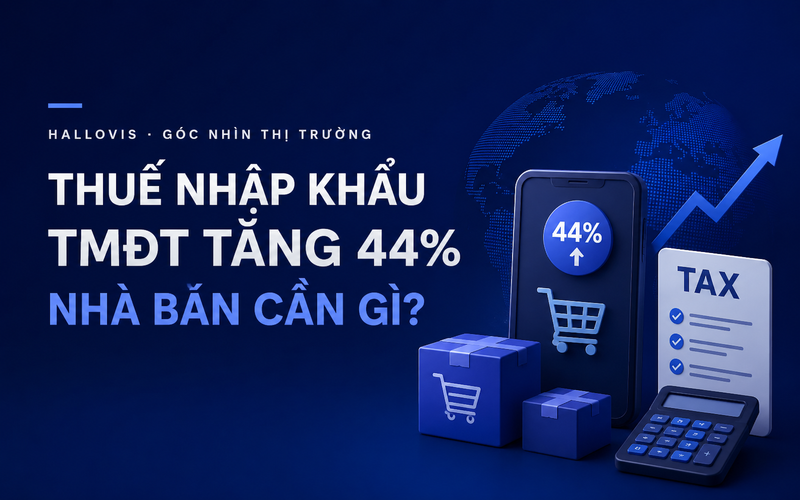
Vietnamese e-commerce grew 44% in H1 2026: the market is up, but not every shop is getting a share of it
The four big marketplaces hit 291.6 trillion VND in the first half of 2026, up 44.11%. But the number of shops and the number of items sold did not rise anywhere near that fast. This is what that gap means.

Vietnamese e-commerce grew 44% in H1 2026: the market is up, but not every shop is getting a share of it
Look only at the headline number and Vietnamese e-commerce has had a very good first half.
In the first six months of 2026, sales across the four big marketplaces — Shopee, TikTok Shop, Lazada and Tiki — reached roughly 291.6 trillion VND, up 44.11% on the same period last year.
On average, Vietnamese shoppers are now spending about 1,611 billion VND a day online.
Reading that, a shop owner might reasonably conclude that selling has got easier.
If you are actually selling on those marketplaces, you may be experiencing the opposite.
Market revenue is up sharply, and the business has not got any easier.
Those two things are not in conflict.
The market grew 44%, but shops and units sold did not grow with it
This is the part of the data worth stopping on.
Revenue up 44.11%.
Units sold up only 13.67%, to about 2.186 billion items.
Shops with at least one order up only 14.11%, to about 613,800.
Put those three side by side and one thing is clear:
Money is growing faster than the number of items sold and the number of sellers.
Put more simply, the market is not just selling more. Shoppers are spending more per purchase.
Which is why the price mix now matters.
Product groups from 200,000 VND upwards are taking a larger share. Items above 1 million VND alone account for about 18.2% of total sales.
Vietnamese shoppers are no longer going online only to hunt for items worth tens or hundreds of thousands of dong.
Given enough confidence, they will buy higher-value products.
And this is where the game starts to change.
The shop with the most orders is not necessarily the shop benefiting most from the growth.
The shops taking the larger slice are the ones with a good product, a higher order value, and enough credibility for a customer to spend real money.
One market, two ways of counting — but the same story
One point is worth making clear when reading Vietnamese e-commerce data.
Metric puts first-half sales across the four marketplaces at 291.6 trillion VND, while YouNet ECI puts it at around 264,800 billion VND, up 19%.
The two figures differ because the two firms collect and measure differently.
Set the methodology aside and one thing is hard to dispute:
Vietnamese e-commerce is still growing.
What has changed is that this year's growth no longer means every seller gets an equal shot.
The market is getting bigger, and the slices are being cut differently.
Higher revenue does not mean more money in your pocket
This is the part that troubles shop owners most.
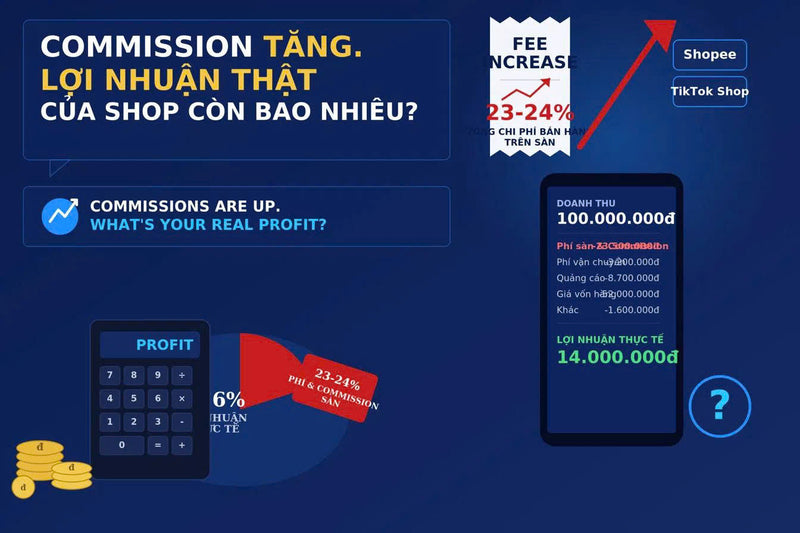
Marketplace fees are rising in several categories. Sellers report total selling costs reaching around 23–24% of revenue in many cases, before advertising.
So this situation is easy to end up in:
Revenue this month is higher than last month.
Orders are up.
The dashboard looks good.
Then you sit down at month end and add it up.
Profit has not moved. Sometimes it has fallen.
This is not rare.
On a marketplace, revenue is simply the most visible number.
Behind it sit marketplace fees, payment fees, advertising, vouchers, operating cost, packaging, returns, shipping subsidies.
Without separating each of those out, it is easy to feel the shop is growing well while it is in fact selling on an ever-thinner margin.
Three questions to ask yourself right now
1. How much does one order actually bring you?
Not revenue.
Not selling price.
The money left after every cost.
Take your best-selling product.
One order at 500,000 VND.
After marketplace fees, advertising, vouchers, operations, packaging and the return rate.
What is left?
If you have to guess, that is the first job.
In a period of rising fees, knowing revenue without knowing margin is not enough to run a shop.
2. If a marketplace changed its policy tomorrow, how much revenue would you lose?
An uncomfortable question, but worth asking.
If 80% of your revenue comes from one marketplace, then a change to its fees, its algorithm or its selling rules changes your results with it.
That does not mean leaving the marketplaces.
They remain one of the most important ways to reach customers.
But a healthy shop should not have only one place to live.
Marketplaces give you traffic.
Your own channels let you keep customers, look after repeat buyers, and hold more control over margin.
Which is why more shops are starting to build their own website, their own customer database, a community, or direct sales channels of their own.
3. How well do you actually understand your own data?
Many shops have plenty of numbers.
Daily revenue.
Order count.
Ad spend.
Conversion rate.
Page views.
Return rate.
But ask:
"Which SKU makes the most money?"
"Which SKU sells a lot and earns almost nothing?"
"Which customers are likely to buy again?"
"Which campaign should continue and which is burning budget?"
and not every shop can answer straight away.
That is the gap between having data and using data to run the business.
The work that decides survival is usually the work nobody wants to do
Launching a campaign is exciting.
Livestreaming feels like making sales.
A new product shows results you can see.
Sitting for hours going back through marketplace fees, working out margin per SKU, checking the return rate, seeing how dependent the shop is on each channel.
Honestly, nobody enjoys that.
But that back-of-house work is what decides whether a shop is genuinely healthy.
Especially now the market has entered a phase where growth is no longer for everyone.
This is the problem Hallovis set out to solve with the 72-Hour Rapid Assessment.
Instead of the owner gathering every report, reconciling every fee line and guessing where the problem sits, Hallovis goes through four things with you:
-
Where is the shop actually making money?
-
Where are cost and margin leaking?
-
How dependent is the shop on each marketplace?
-
What should be dealt with first to improve results?
After 72 hours the point is not to hand you one more report to file away.
It is to let you see clearly where the shop stands and what to handle first.
There is still plenty of opportunity. The game has just changed
291.6 trillion VND in six months is a big enough number to establish one thing:
The opportunity in Vietnamese e-commerce is still large.
The question is not whether the market is growing.
It is whether you are growing with it.
Some shops are up 40% in revenue with profit standing still.
Some shops have not grown orders much, but their order value is higher and they keep more of the money.
And some shops still look good on revenue, until the day a marketplace changes its policy.
So the second half of 2026 is probably not about:
"How do we sell more?"
It should be:
"How do we make each dong of revenue produce more profit, and how do we depend less on things we do not control?"
The market is getting bigger.
As the pie grows, so does the competition.
And at some point the question stops being which shop is selling.
It becomes:
Which shop is healthy enough to go the distance?
Contact Hallovis for a growth health assessment of your shop within 72 hours.
Need advice on solutions suitable for your industry?
Hallovis advises free of charge, matched to your scale and your sales channels. We reply within 01 to 02 business days.